China and Russia Promise Joint Arctic Fleet in New Pact
A St. Petersburg communique details plans for shared vessel construction and freight routes, aiming to bypass Western restrictions in the region.
By Samir Patterson ·
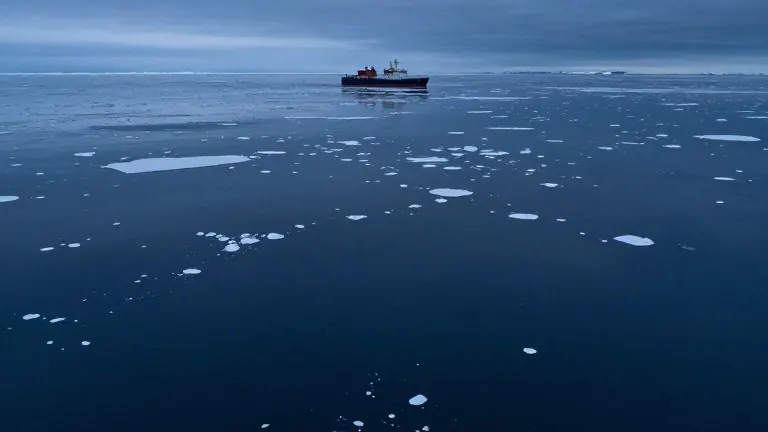
Chinese and Russian leaders released a joint statement on October 21 that formalizes a new phase of cooperation in the Arctic. The document, issued after a government meeting in St. Petersburg, outlines specific commitments to increase cargo traffic along northern shipping lanes. It also directs the two nations to jointly build ice-class vessels for polar operations. The statement pledges government support for private enterprises from both countries engaged in Arctic projects.
The agreement highlights the growing economic and military integration of Beijing and Moscow. The Arctic region spans 14.5 million square kilometers and is home to only eight sovereign states. While the United States qualifies as an Arctic nation due to Alaska, China is not a full member. Beijing declared its intent to become a polar great power in 2014. Since then, it has invested heavily in the region. A 2022 estimate by the House Foreign Affairs Committee placed Chinese investment in Arctic resources at $90 billion since 2003.
Military coordination between the two powers has accelerated. In July 2024, Russian and Chinese strategic bombers flew a joint patrol over the Bering Sea. They entered the air defense identification zone near Alaska for the first time. US and Canadian fighter jets intercepted the aircraft. Senator Dan Sullivan of Alaska called the event an escalation. He noted that it was the first time a joint bomber task force had entered the Alaska ADIZ. The two countries also conducted their first joint naval patrols in the Arctic Ocean during the Ocean 2024 exercise.
China is expanding its scientific presence in the region as well. In July, Beijing deployed four research ships to the Arctic Ocean simultaneously for the first time. These vessels were part of the 16th annual Arctic expedition. They transited through the US exclusive economic zone and over the extended continental shelf in the Bering Sea. US Coast Guard officials reported monitoring the ships closely. Rear Admiral Bob Little stated that the US is actively responding to competitor activities in the increasingly contested Arctic. Defense officials suggested that dual-use equipment on the ships could be used for mapping subsea infrastructure or tracking submarines.
The US has moved to secure its position in Greenland, an autonomous territory of Denmark. In September, the United States, Denmark, and Greenland signed a trilateral security agreement. The pact updates a 1951 treaty and prohibits non-NATO countries from building military bases or deploying troops on the island. It specifically names China and Russia as targets of these restrictions. The agreement also limits foreign direct investment from non-NATO and EU nations in sectors such as critical minerals and ports. Chinese companies are categorized as Article X Investors, facing a default assumption of restriction. This follows failed attempts by Chinese firms to acquire Greenlandic airports and mining rights in previous years.
Analysts note that China’s lack of voting power in the Arctic Council constrains its influence. Russia serves as a gatekeeper for Chinese access to the region. Elizabeth Wishnick, a polar strategy expert, stated that Russia continues to act as a gatekeeper to China’s ability to operate in the Arctic. Despite these barriers, Beijing views the Arctic as a long-term strategic asset. Melting ice is opening new trade routes that shorten transit times between Asia, Europe, and North America. Bobo Lu, a fellow at the Lowy Institute, said the Arctic is about planning for the future as governance issues become more live.