Filmmakers Urge Japan to Simplify Incentives Amid New Government Push
Industry leaders argue that current approval processes are too slow and unclear, prompting calls for automatic systems as Tokyo prepares a new unified content authority.
By Samir Patterson ·
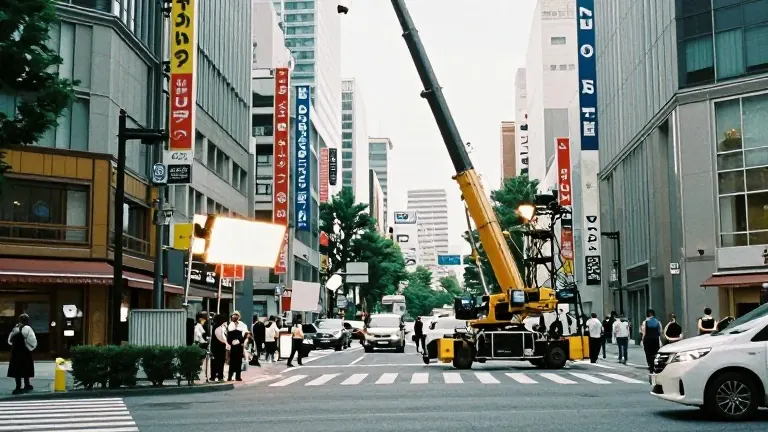
Filmmakers told a Tokyo audience on October 27 that Japan’s current production incentives lack the certainty needed to attract major international shoots.
Speaking at the Motion Picture Association’s annual seminar during the Tokyo International Film Festival, producers and policy directors outlined specific changes to the country’s support schemes. These remarks coincided with the government’s preparation of a new body designed to consolidate fragmented content industry support.
Alex Boden, a London-based producer who spent nearly two years in Japan for HBO Max’s "Tokyo Vice," traced the evolution of the support scheme from a 2020 research program to the current IP360 model. IP360 offers a 50% rebate against Japanese spending. Boden argued that the minimum spend requirement, now set at 800 million yen, or roughly $5.1 million, excludes many independent films and co-productions. He noted that most Japanese films cost between $1.5 million and $3 million.
Boden called for an automatic approval system to replace the current panel-based selection process. He observed that Japan is one of the few territories using a subjective incentive structure, which is problematic given that projects often take three to five years to develop. He cited Martin Scorsese’s "Silence," "Pachinko," and "Shōgun" as examples of Japan-set projects that scouted locations in the country but ultimately filmed elsewhere. He suggested incorporating training components into the scheme, similar to the 0.5% ScreenSkills levy used in the United Kingdom.
Deb Richards, production policy director at Netflix, emphasized that certainty matters more than the size of the rebate. She stated that a lower incentive is acceptable if the criteria are clear, describing the current Japan process as opaque. She explained that applicants can only deduce why they were rejected by examining who was approved.
Paul Muller, the MPA’s VP of production policy for Asia-Pacific, pointed to Australia as a comparative example. There, international productions must spend at least 20 million Australian dollars and direct 1% of their budget to training. Since that rule took effect in June 2023, more than 20 million Australian dollars have been allocated to training. Muller noted that the average cost of an hour of Australian television has risen from 2 million Australian dollars to between 5 million and 6 million Australian dollars over the past seven or eight years.
Georgina Pope, head of production at Toho Tombo Pictures, said permitting in Tokyo remains difficult but is improving. Her team recently closed the road in front of Tokyo City Hall for a large car scene for a recent project. She observed that Japan is beginning to recognize the value of a dynamic international film industry. Boden agreed, calling Japan the hottest country in the world at the moment and warning that delay would represent a missed opportunity.
On the government side, Nakahara Hirohiko, director-general of the Cabinet Office’s Intellectual Property Strategy Promotion Secretariat, confirmed that a task force on the new entity held its first meeting on October 22. The body is ordered directly by the Prime Minister and aims to break down divisions among ministries handling content policy. The government aims to launch the new organization in 2027 as part of a roadmap targeting 20 trillion yen in overseas sales by 2033. Amari Akira, former METI minister, described the new approach as a plan to quadruple the industry in ten years through multiplication rather than addition.
More News · National news · Report a business · Got a Story?