UTSA Team Prints Filters from Seaweed
A new EPA grant supports a project to turn Gulf Coast Sargassum into reusable 3D-printed modules that capture agricultural runoff before it reaches the ocean.
By Samir Patterson ·
Residents along the Gulf Coast face a recurring summer nuisance as massive mats of golden-brown Sargassum seaweed wash ashore. In small amounts, this species provides shelter for marine life, but recent overgrowth has piled millions of tons onto beaches. The rotting vegetation suffocates local ecosystems, drives tourists away, and releases toxic gases like hydrogen sulfide.
The root cause lies upstream, where agricultural and urban runoff dumps excess nitrogen and phosphorus into coastal waterways. These nutrients feed algal blooms and create massive marine dead zones. Researchers at the UT San Antonio Margie and Bill Klesse College of Engineering and Integrated Design are developing a solution that addresses both the seaweed inundation and the nutrient pollution.
Shalinee Kavadiya, an assistant professor in the Department of Biomedical and Chemical Engineering, leads the effort. Her team transforms harvested Sargassum into 3D-printed, reusable filtration modules. These units are designed to catch runoff nutrients before they reach the ocean. Kavadiya notes that the problems of Sargassum overgrowth, nutrient pollution, and waste management are typically treated independently. Her research connects them through a sustainable manufacturing solution.
The project began receiving support in September 2026 through a three-year grant. The U.S. Environmental Protection Agency awarded $735,532 through the Gulf of America Program. Kavadiya works with co-principal investigator Vikram Kapoor, a Klesse Endowed Professor in Civil and Environmental Engineering. Together, they transform decaying seaweed into water treatment technology.
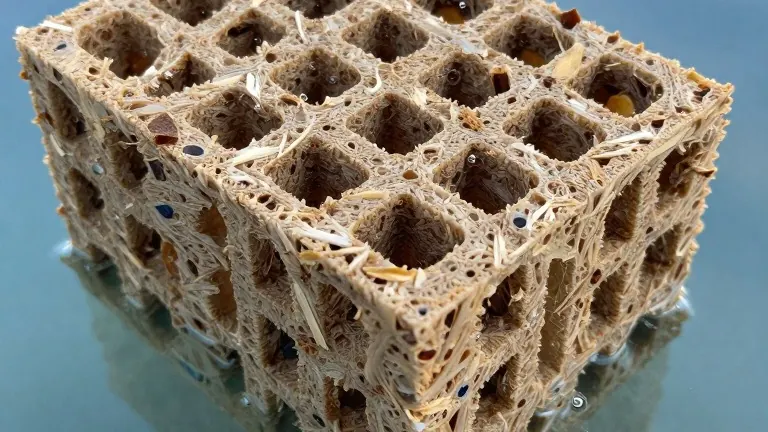
The fabrication process starts with Sargassum collected along the Texas coast. The team dries and powders the seaweed, then converts it into organic, inorganic, and composite materials. These materials form porous filtration units that feature a 3D-printed backbone. A functional material coating binds with nutrients like phosphorus and nitrogen. The modules stack with varying pore sizes to trap physical sediment at the entry point and collect dissolved chemicals deeper inside.
Kavadiya says 3D printing allows for easy and reproducible fabrication of these filtration units. The method offers control over the physical form of the structures. The design supports a goal of creating a system that is reused rather than discarded after one use. Traditional commercial stormwater filters rely on single-use minerals that end up in landfills once saturated.
The team plans to test the filtration system in the field to assess its efficiency and durability. This analysis will help coastal communities and government agencies evaluate the modules as a potential solution at scale. By the end of the project, Kavadiya expects the team to determine how frequently filters need replacement based on water flow and size. The researchers will also conduct an economic analysis to compare this technology with existing options. Long-term, they hope to recycle the collected nutrients for use as agricultural fertilizer, shifting the focus from waste management to resource recovery.