68 Dead in Spain Rail Crash That Exposed System Failures Weeks Before Vote
A computer malfunction and a conflicting order from central control led to the collision in Toledo province, marking the second fatal accident on the network in less than a year.
By Charlotte Dubois ·
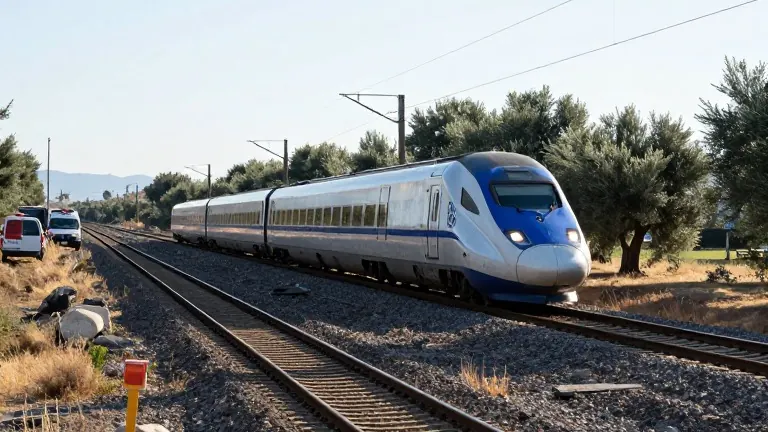
Sixty-eight people died Wednesday when a high-speed train in central Spain struck a stationary train from behind, killing the largest number of passengers in a single rail accident in the country's modern history.
The crash occurred near the town of Urda in Toledo province at 8:53 a.m. The collision happened just four weeks before Spaniards cast ballots in a national election scheduled for November.
Transport Minister Óscar Puente identified the cause as a failure in the central command system. He stated that a security system on a 63-kilometer stretch of track stopped working due to a computer malfunction at 8:30 a.m. This forced all trains on that line to halt.
At the time of the failure, an IRYO train was stopped near Urda. A state-owned RENFE train was 25 kilometers behind it. Minutes later, the central control center ordered the RENFE train to resume movement without speed restrictions.
Puente said the RENFE train should have remained stopped because a stop signal was still active on the line. He noted that even if the train was cleared to move, it should have been instructed to travel at reduced speed. He described the order as inexplicable and stated that the train engineers were not to blame.
This is the second deadly high-speed rail disaster in Spain this year. In January, 46 people died when a train derailed and struck the side of another train in southern Spain. Before these two incidents, the network had not experienced a fatal crash since its launch more than three decades ago.
Prime Minister Pedro Sánchez visited the site after regional authorities confirmed the death toll. He declared three days of national mourning starting Thursday. Sánchez pledged to reinforce safety measures to rebuild public trust in a system that carried 45 million travelers last year.
"It is clear that we need to reinforce the safety of our train service to rebuild the trust in our high-speed rail," Sánchez said. "It is not acceptable for a country like Spain to endure two high-speed train accidents in the same year."
The accident complicates the political landscape for Sánchez ahead of the vote. Polls indicate his Socialist party faces an uphill battle. Sánchez had called for early elections earlier this month, hoping to leverage voter discontent over housing costs. The crash adds infrastructure concerns to existing criticisms regarding migration policy and corruption accusations leveled against his party.
Opposition leaders responded quickly. Popular Party leader Alberto Núñez Feijóo demanded a full investigation and canceled his party's campaign events for the day. Far-right Vox leader Santiago Abascal criticized the government, calling it a criminal organization and promising to work until it faced a courtroom.