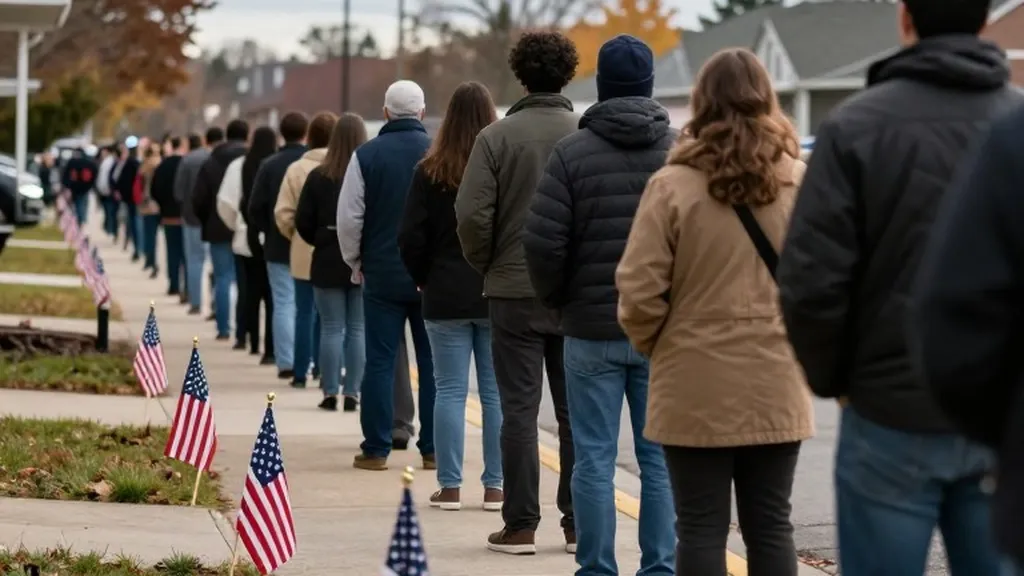
Voters in Raleigh and Palm Beach weigh tariffs, taxes, and the cost of living
AP-NORC data shows economic anxiety as the dominant factor, with specific concerns about healthcare and taxes driving turnout in key swing states.
By Charlotte Dubois ·
On this Election Day, the central question facing voters is not who is on the ballot, but how the price of daily life has changed. The Associated Press describes the 2026 midterm election as a referendum on President Donald Trump's second term, noting that voters are struggling with high prices and are angry over an unpopular war with Iran. This economic strain is visible in polling data and in the comments of individuals casting ballots across the country. The results will determine who controls Congress for the final two years of the current administration, a decision that carries significant implications for policy oversight and the direction of the nation's economic strategy.
The AP-NORC polling provides a clear snapshot of this sentiment. Currently, 35 percent of U.S. adults approve of Trump's job performance, while only 25 percent approve of his handling of the economy. Approximately seven in 10 Americans say the country is heading in the wrong direction, and the majority of those respondents blame the president for high prices. These numbers suggest that the economic mood is a powerful force in this election, potentially outweighing other traditional partisan alignments. As polls open across the country, these statistics serve as a baseline for understanding why so many voters are heading to the polls with a specific focus on their wallets.
In Raleigh, North Carolina, the local impact of these national trends is palpable. James Moore, a 57-year-old librarian, articulated a sentiment shared by many in the region: "I'm paying more taxes. I'm paying more for my healthcare. I'm paying more for everything." His comments reflect the tangible reality of the cost of living crisis that the AP identifies as a top issue. Moore's experience is not an anomaly but a representative case of the broader economic anxiety that has driven voter turnout. In states like North Carolina, which uses a new congressional map after mid-decade redistricting, these individual economic concerns are aggregated into a collective political signal that could influence the outcome of close Senate and House races.
Contrasting this view is the perspective from Palm Beach Gardens, Florida, where voter Mark Barker offered a different assessment. Barker stated, "I've just been following Trump the whole time. I really think he's doing an awesome job." This divergence in opinion highlights the complexity of the electorate. While the AP-NORC data indicates a majority view that the economic trajectory is negative, a significant portion of the population remains supportive of the current administration's approach. Florida is a critical battleground, with a special Senate election and a competitive governor's race. The state's new congressional map adds another layer of complexity, as the AP notes that new districts may not vote exactly as drawn due to shifting local demographics and economic pressures.
The role of tariffs in this economic narrative cannot be overlooked. The AP points to the state of Maine as a prime example of how economic strain and tariffs have made a traditionally stable state competitive. In Maine, Senator Susan Collins faces a challenge from Democratic former state Senate President Troy Jackson. The AP notes that the state's economy, heavily tied to trade and tourism, has felt the effects of recent tariff policies. This is a microcosm of the national debate, where voters in various regions are weighing the costs of protectionist trade measures against the perceived benefits of domestic production. The AP-NORC polling suggests that these specific economic grievances are resonating with a broad swath of the electorate, contributing to the overall dissatisfaction with the current economic direction.
The financial resources behind the campaigns also reflect the high stakes of this economic referendum. The 2026 elections are likely to be the most expensive in history. Republican committees have outraised and outspent Democratic committees at the national level, aided by Trump-affiliated groups and Elon Musk. However, at the candidate level, Democrats have outraised their opponents. An analysis by the AP of AdImpact data reveals that 88.1 percent of Republican general election TV ad spending went to states and districts that Trump won in 2024. This strategic allocation suggests that Republicans are focusing on consolidating their base in areas where the economic message has been more favorable, while Democrats are working to turn the economic tide in swing states and districts.
In Raleigh, the presence of new congressional maps is a key factor in how these economic votes are translated into seats. North Carolina is one of six states using new maps after mid-decade redistricting. The AP notes that 21 Democratic-held districts voted for Trump in 2024, while nine Republican-held districts voted for Kamala Harris. This overlap indicates that economic preferences are not strictly partisan but are influenced by local conditions and specific policy impacts. For voters like James Moore, the new map may mean that their economic concerns are being heard in a different context, potentially altering the competitive dynamics of the race. The AP identifies 46 battleground districts in the House, and the economic mood in places like Raleigh will be a decisive factor in many of these contests.
The mood in Palm Beach Gardens reflects the tension between local and national economic narratives. While the AP-NORC data shows a national trend of economic dissatisfaction, individual voters like Mark Barker may prioritize different aspects of the economy. The AP notes that Republicans were bracing to lose the House and fighting to hold the Senate, with one or two seats potentially tipping either chamber. This narrow margin of error underscores the importance of every vote. In Florida, the special Senate election for the rest of Marco Rubio's term is a key race, with Ashley Moody as the Republican incumbent. The AP notes that Trump's administration filed a lawsuit related to the certification of the Senate result in Alaska, a move that has raised concerns about election interference, but the primary focus for most voters remains the economic issues that affect their daily lives.